What is a TCG? Trading Card Games Explained (Types, Rules & How They Work)
New to trading card games? Learn what a TCG is, how it works, the main types of card games, and what you need to start building your own.
Magic: The Gathering has been selling randomized cardboard since 1993 — and it still generates over a billion dollars a year. Yu-Gi-Oh, Pokémon, Hearthstone. The format refuses to die. If anything, it keeps growing.
So what exactly makes a trading card game work — mechanically, visually, and as a business? This guide breaks it down from the ground up: the definition, the formats, the core mechanics, and what it actually takes to build one from scratch.
What Does TCG Stand For?
TCG stands for Trading Card Game. It is also commonly called a CCG (Collectible Card Game) — the two terms are used interchangeably, though there is a subtle difference:
- TCG emphasizes the trading aspect — players buy, sell, and trade individual cards to build their decks.
- CCG emphasizes the collecting aspect — cards are obtained through booster packs with randomized contents, similar to collecting stickers or sports cards.
In practice, most modern games are both. You collect cards through packs and trade them with other players. Magic: The Gathering, the genre's grandfather, uses both terms depending on the context.
How Does a Trading Card Game Work?
At its core, every TCG follows the same basic structure:
1. Deck Building Each player constructs a personal deck from their card collection before the game begins. Decks are typically 40–60 cards and follow rules about which cards can be combined and how many copies of each card are allowed.
2. Drawing and Hand Management Players draw a set number of cards at the start of their turn. Managing what is in your hand — when to play cards, when to hold them — is a core skill of the genre.
3. Resources Most TCGs use some form of resource system to control how many cards you can play each turn. Magic uses Mana (land cards). Hearthstone uses a Mana crystal system that grows each turn. Yu-Gi-Oh has no traditional resource system — you can play one monster per turn by default.
4. Win Conditions Most TCGs end when a player runs out of life points, cannot draw a card, or meets a specific game condition. The exact win condition varies significantly between games.
The Main Types of TCGs
Not all trading card games are the same. The genre has branched into several distinct formats over the decades.
Classic Dueling TCGs
The original format. Two players face each other with constructed decks, taking turns attacking and defending until one player wins. Magic: The Gathering, Yu-Gi-Oh, and the Pokémon TCG all follow this structure. This is the most competitive and widely played format globally.
Deck-Building Games
Players start with identical weak decks and acquire better cards during the game itself from a shared central pool. There is no pre-game collection or trading required. Dominion pioneered this format. It is popular with board game designers because it requires no ongoing investment from players.
Living Card Games (LCGs)
A variation of the CCG model where all cards in a set are available in fixed, non-randomized packs. No rare card lottery — every player has access to the same card pool. Android: Netrunner and Arkham Horror: The Card Game use this model. It is considered more fair and accessible than traditional TCGs.
Digital TCGs
Online-only card games that follow TCG mechanics but exist entirely in software. Hearthstone, Legends of Runeterra, and Marvel Snap are the most prominent examples. Digital TCGs can introduce mechanics impossible in physical games — cards that change stats, randomized effects, and animated boards.
Hybrid and Indie TCGs
A growing category of games that blend TCG mechanics with RPGs, deckbuilders, and roguelikes. Games like Slay the Spire and Monster Train are technically single-player deckbuilders, not traditional TCGs, but they share the same DNA. This is where most indie developers currently experiment.
What Makes a Good TCG?
Three elements separate memorable TCGs from forgettable ones:
Depth without complexity. The best TCGs are easy to learn in 10 minutes but take years to master. The rules are simple — the strategy is deep. If your rulebook needs 40 pages before a new player can start, you have a problem.
A strong visual identity. Cards are physical or digital objects that players hold, collect, and show off. The art style, border design, and color system are not decoration — they are part of the product. A cohesive visual language makes your game feel like a real world, not a spreadsheet with pictures.
A balanced meta. Every card needs to be useful in some context. A card that is strictly worse than another card in every situation is wasted design space. Competitive players will always find the optimal strategy — your job is to make sure multiple strategies can compete.
How Do Trading Card Games Work as a Business?
The traditional TCG business model is built on randomized booster packs. Players buy packs hoping for rare or powerful cards — a mechanic that drives repeat purchases and secondary market trading. This is why rare cards can be worth hundreds or thousands of dollars.
For indie developers, this model is difficult to replicate. Print-on-demand services like MakePlayingCards allow small studios to produce physical cards, but the logistics of randomized packs, secondary markets, and tournament support are complex to manage alone.
Most indie TCG projects launch digitally first — lower production costs, instant distribution, and built-in tools for managing card pools and balance updates.
The biggest mistake first-time TCG designers make is starting with 200 cards. Start with 40–60 cards maximum. Prototype the core loop first — resource system, win condition, turn structure. Visual design comes after mechanics are proven.
Ready to Build Your Own Trading Card Game?
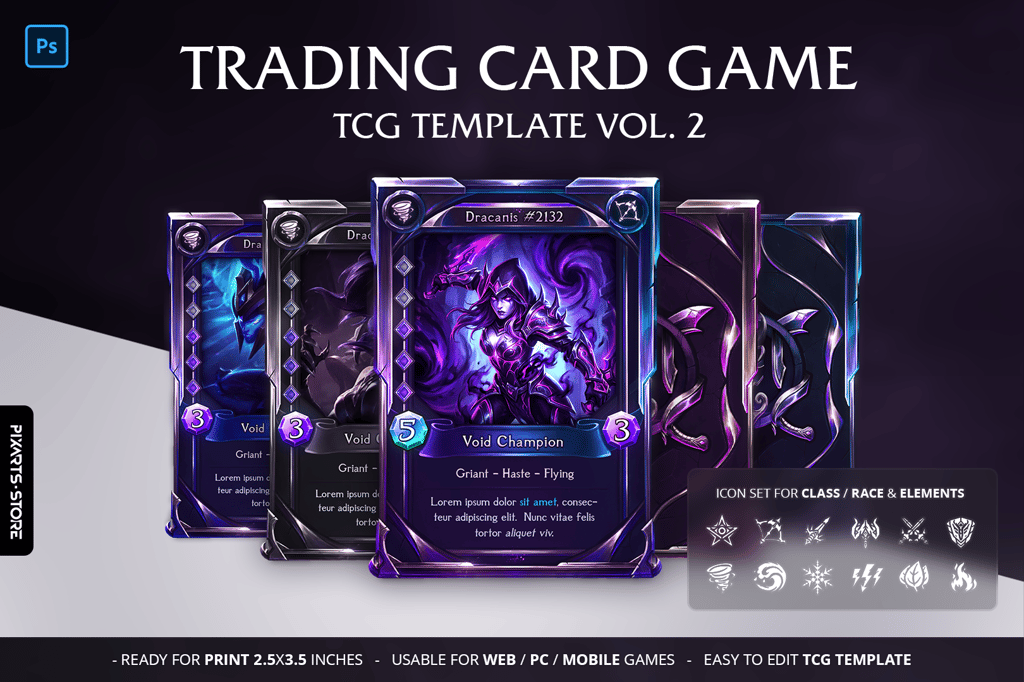
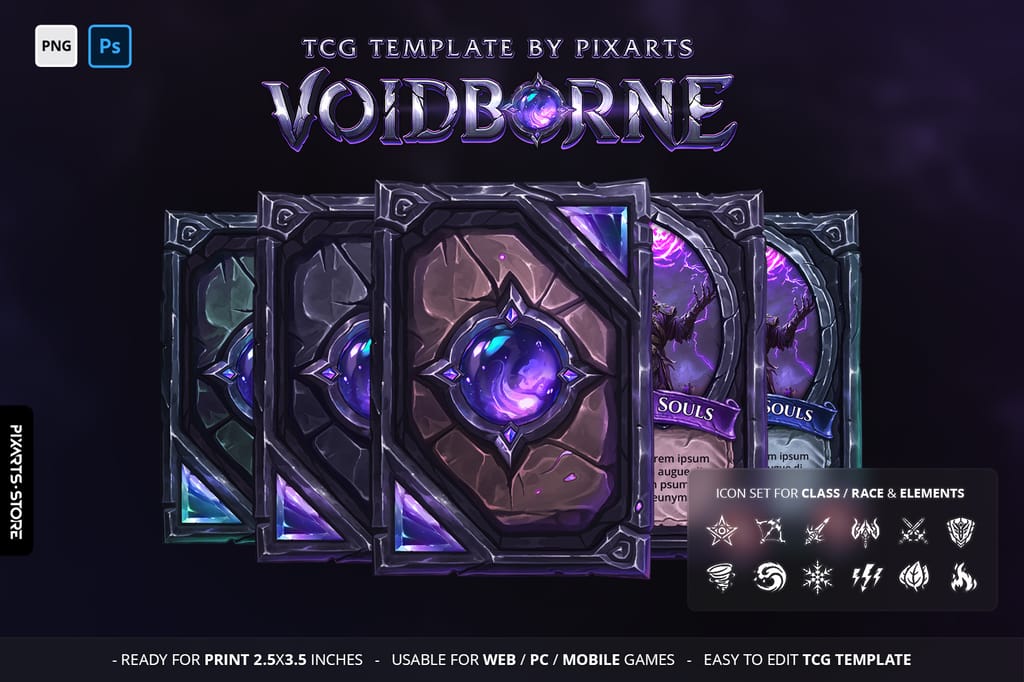
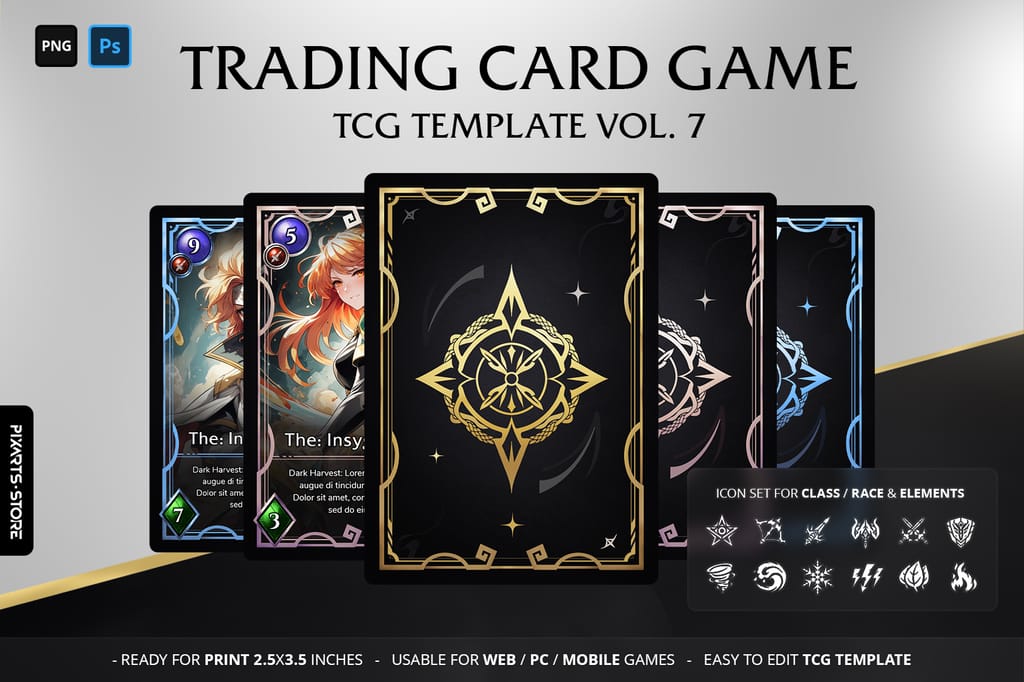
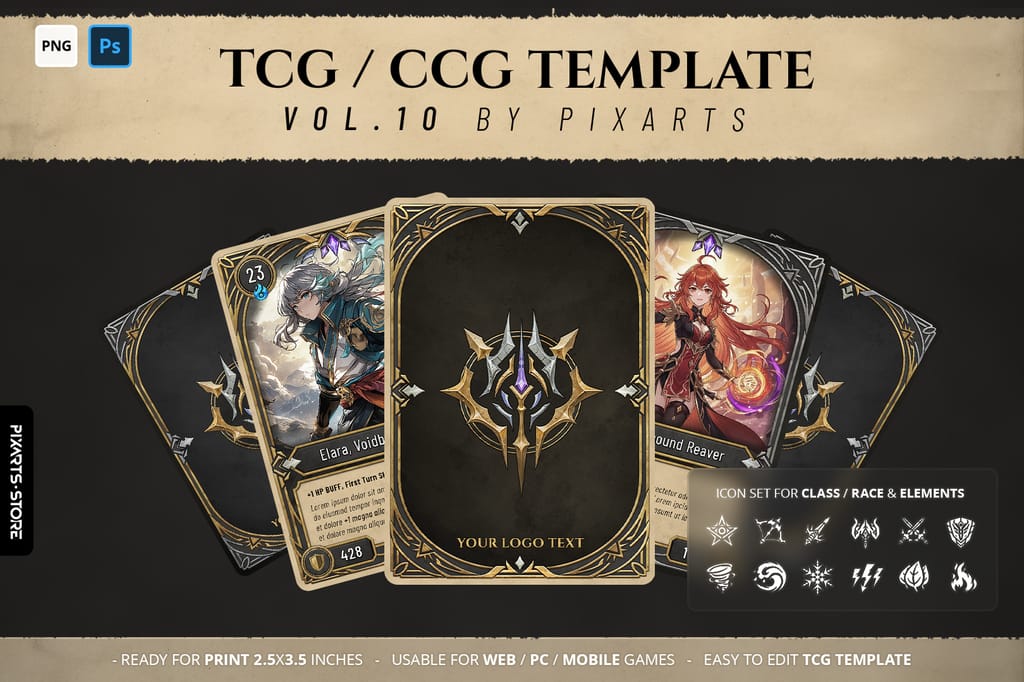
If you are past the "what is a TCG" stage and ready to start building, the first practical step is getting your card template right. A well-structured template defines your card's visual language, stat layout, and art frame from day one — and saves you from rebuilding everything mid-project.
Here are a few starting points depending on your game's aesthetic:

Dedicated to empowering game developers with premium digital assets. We specialize in crafting immersive UI designs, distinct logos, and web solutions that take your game project to the next level.